Episode 51
Transportation
1:15:36
Inside ODOT: Layoffs, Funding & Oregon’s Transportation Fight
Mary Dirksen
ODOT employee
ABOUT THIS EPISODE
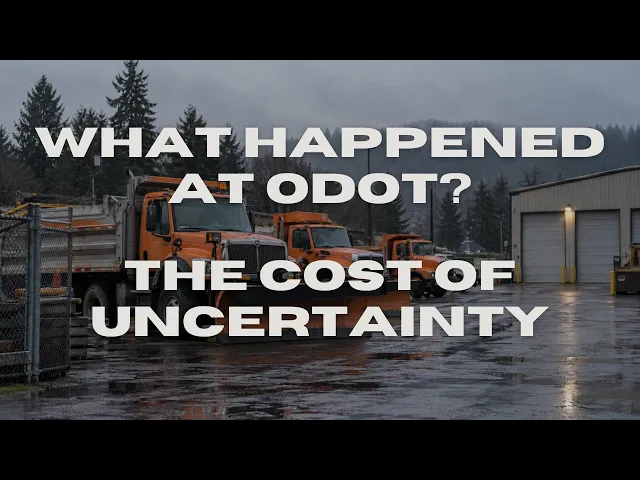
Mike McLane sits down with Mary Dirksen, a 24-year ODOT employee speaking from her personal experience, to discuss what Oregon’s transportation funding fight looked like from inside the agency. They cover layoff notices, employee turnover, budget uncertainty, government bureaucracy, workplace culture, and the larger question of how Oregon funds essential transportation services after voters rejected Measure 120.
SHOW NOTES
Inside ODOT: What Oregon’s Transportation Funding Fight Looked Like to State Employees
Oregon’s transportation debate has largely been told through tax proposals, legislative votes, agency budgets, campaign arguments, and election results.
But behind those numbers were thousands of Oregon Department of Transportation employees trying to understand whether they would still have jobs.
In this episode of Oregon Discussion, State Senator Mike McLane talks with Mary Dirksen, a 24-year ODOT employee and senior HR policy analyst. Dirksen emphasizes that she is speaking in her personal capacity rather than on behalf of ODOT. She is also currently a candidate for Oregon Senate District 19. Her campaign biography likewise describes 24 years of state public service and her work as a senior policy analyst.
The episode provides a different perspective on one of Oregon’s largest recent policy fights: not simply whether the state should raise transportation revenue, but what prolonged uncertainty does to the people responsible for maintaining a major public agency.
How Oregon Arrived at the Transportation Funding Fight
Oregon has faced a growing mismatch between transportation revenues and the cost of maintaining the state system.
ODOT says fuel-tax revenues have become less sufficient as vehicles have grown more fuel efficient and costs for labor and transportation materials have increased. The agency also receives significant federal transportation funding, but those dollars are often restricted to particular programs and capital uses rather than being freely available for everyday maintenance and operations.
The Legislature attempted to address the problem in 2025 through House Bill 3991. The package included increases in the state gas tax, registration and title fees, and the payroll tax supporting public transportation.
The eventual referendum became Measure 120. A “Yes” vote would have retained those tax and fee increases; a “No” vote would repeal the referred portions and leave the gasoline tax at 40 cents per gallon.
Oregonians rejected the referred tax and fee increases by a wide margin in the May 2026 primary. Election-night statewide results showed more than 80% voting against the measure.
That result did not, however, eliminate Oregon’s underlying transportation funding problem.
A Transportation Package Unlike 2017
Mike McLane contrasts the 2025 process with Oregon’s 2017 transportation package.
House Bill 2017 passed both legislative chambers with votes from Democrats and Republicans. The joint transportation committee that developed it worked for roughly a year, held hearings, toured transportation facilities and organized policy work groups before the legislation passed.
McLane’s criticism in this episode is that the 2025 process became substantially more partisan and that Republican legislators were not meaningfully involved in the final negotiations.
That is his political interpretation of the process. What is independently clear is that lawmakers failed to reach a transportation agreement during the regular 2025 session, Gov. Tina Kotek later called a special session, and a smaller funding package ultimately passed before portions were referred to voters.
For Dirksen, however, the political mechanics were secondary to what was happening inside ODOT.
Getting the Layoff Call While Recovering From Surgery
One of the strongest moments in the episode comes when Dirksen describes receiving notice that her position had been selected for layoff.
She was recovering from a serious surgery and expected to remain on medical leave until late August. Then her supervisor called on a Saturday.
Dirksen says she learned that her job was scheduled to end at the end of July.
After 24 years at ODOT, she initially believed she might simply recover from surgery and never return to the agency.
The timeline then kept changing. According to Dirksen, employees received extensions as lawmakers worked through the transportation fight and special session. She describes receiving multiple notices and changing dates, creating a prolonged period in which employees did not know whether their jobs would survive.
The significance of that story is broader than one employee.
Budget uncertainty eventually becomes workforce uncertainty.
Hundreds of ODOT Positions Were at Risk
Dirksen describes approximately 483 employees as having been targeted for layoffs during the earlier process.
ODOT's own 2026 budget materials later estimated that, without legislative action, approximately 470 employees would have lost their jobs, with more than 1,000 positions affected when vacancies were included. ODOT also reported that more than 360 employees had already left the agency since July 2025 amid the uncertainty.
That distinction matters.
The threatened layoffs were eventually prevented, but the agency still experienced workforce loss.
Dirksen tells McLane that she saw turnover among both employees and leadership and describes uncertainty as damaging to workplace stability. ODOT meeting records from September 2025 similarly reported that more than 250 employees had left in recent months by that point.
The 2026 Legislature Prevented the Layoffs — Temporarily
The transportation story did not end with Measure 120.
In March 2026, lawmakers redirected existing transportation dollars to address ODOT’s budget shortfall. ODOT says the legislation shifted approximately $218 million from other state transportation funds to maintenance and operations, preventing approximately 470 layoffs and maintaining services including highway maintenance, storm response and DMV operations.
That was a short-term solution rather than a permanent answer.
ODOT itself describes the action as stabilizing operations through the current budget cycle while leaving the State Highway Fund’s long-term funding challenge unresolved.
That unresolved question is important to the episode.
Oregon rejected one revenue proposal. The need to maintain roads, bridges, DMV services and emergency response did not disappear with the vote.
The debate now shifts toward what Oregon should fund, how efficiently ODOT should operate, and where sustainable transportation revenue should come from.
What Uncertainty Does to an Agency
Dirksen’s most useful contribution may be less about taxes than organizational culture.
She describes employees living through months of uncertainty over whether they would be laid off, whether funding would arrive, and what the agency would look like afterward.
Some employees left voluntarily.
Some leaders left.
Others stayed and continued doing the work.
Dirksen is careful not to portray ODOT employees as the cause of the transportation controversy. She repeatedly says there are excellent employees at the agency — people who have spent decades working there and care deeply about ODOT’s mission.
That distinction is worth preserving.
An agency can have structural or policy problems while also containing dedicated employees trying to make the system work.
Is ODOT’s Problem Only Money?
The conversation then broadens.
McLane asks Dirksen whether ODOT functions effectively. From her perspective as an HR policy analyst, one obstacle is the accumulation of laws, administrative requirements and regulations.
She describes layer after layer of requirements coming from both federal and state government. Some may be reasonable individually, but implementing them simultaneously creates complexity for managers and employees.
This becomes one of the episode’s central themes:
Government does not experience new laws only as words on paper. Someone has to administer them.
Every new mandate can require new procedures, training, software, reporting, legal review, HR work and employee time.
Paid Leave Oregon as a Case Study
The hosts use Paid Leave Oregon as one example.
Dirksen explains how paid leave interacts with existing systems such as federal and state family medical leave, disability accommodations, collective bargaining agreements and other workplace rules.
Her argument is not simply that one particular benefit exists. It is that administering multiple overlapping systems creates increasing complexity.
In ODOT’s case, Dirksen says additional staff capacity was needed to manage parts of the leave system.
That experience helps illustrate a larger question for policymakers: when Oregon passes a new employment mandate, does the Legislature adequately account for what implementation will require from both private employers and public agencies?
Pay Equity and Unfunded Administrative Work
Dirksen also discusses Oregon’s pay-equity requirements.
She says ODOT initially distributed pay-equity responsibilities among HR staff before eventually dedicating a position specifically to that work.
Again, the episode is less an argument against the policy goal itself than an argument about implementation.
A legislative requirement may have consequences for staffing and administrative costs even if lawmakers do not appropriate a new line item labeled “implementation.”
Those costs still exist.
Someone has to do the work.
The Cumulative Effect of Regulation
This leads to one of the broader arguments in the episode: Oregon government has become increasingly complicated because individual rules accumulate over time.
Dirksen says that after 24 years working in state government, one of the biggest changes she has witnessed is simply how difficult implementation has become.
An agency may have to coordinate state law, federal law, collective bargaining agreements, vendor systems, administrative rules and internal policies — sometimes simultaneously.
Her preferred reform is simplification: review older laws and regulations, eliminate unnecessary ones, and resist adding requirements without considering the cumulative burden.
Whether a viewer agrees with every policy conclusion or not, the implementation question is valuable.
Government efficiency is not only about reducing headcount. It is also about reducing unnecessary complexity.
Accountability for Taxpayer Money
The episode then moves from transportation into a broader discussion of government spending.
Dirksen tells a personal story involving Medicaid-linked benefits her adopted children received. She says her family received summer assistance without an income verification process and questions whether public resources were sufficiently targeted toward people who needed them most.
This is an anecdote rather than a systemwide audit, so it should not be treated as proof that the entire Medicaid program lacks controls.
But it illustrates the accountability question that McLane raises throughout Oregon Discussion:
When taxpayers fund a program, what mechanisms ensure that the money reaches the intended population and produces the intended result?
Working From Home and the Post-COVID Workplace
Another interesting part of the episode is Dirksen’s description of ODOT before and after widespread remote work.
Before COVID, she worked in an office and describes employees walking down the hall, gathering in conference rooms and solving problems face to face.
She now works remotely and says the arrangement has advantages, but believes something has been lost in communication and workplace camaraderie.
People may be less likely to encounter colleagues from other teams or remember to involve everyone affected by a decision.
That is not unique to ODOT. It is a management question facing employers throughout the economy: what does remote work improve, and what does it make harder?
From ODOT to Oregon’s Larger Challenges
The latter portion of the episode becomes a broader conversation about why Dirksen decided to run for office.
Her campaign priorities, as described in the episode and on her campaign website, include public safety, education, government efficiency and Oregon’s business climate.
She also discusses her family’s experience with the foster-care system, volunteer work at Coffee Creek Correctional Facility, work related to human trafficking and her experience as a parent navigating Oregon schools.
These topics take the episode well beyond transportation, but they help explain how Dirksen views government: from the perspective of someone who has spent more than two decades implementing its policies.
Public Education and Discipline
Dirksen discusses her daughter's difficult experience in public middle school and raises concerns about classroom discipline and restorative-justice practices.
She argues that systems designed around disruptive students can sometimes interfere with the learning of everyone else in the classroom.
The broader education policy debate is more complex than one family's experience, and approaches to restorative practices vary between districts and schools. But her experience illustrates the question she wants policymakers to consider:
How should schools balance intervention for a struggling student with the right of other students to learn in a safe classroom?
Public Safety and Portland
The episode also reflects on Portland.
Both McLane and Dirksen remember downtown Portland in earlier decades as safer and more vibrant. Dirksen worked around Old Town and Chinatown and describes a sharp change over time, particularly surrounding COVID, drug use and public disorder.
The hosts offer political interpretations for why Portland changed, including Measure 110, criminal justice policy and policing decisions.
Those causes remain debated, and Portland’s changes cannot be reduced to one policy. What is clear is that Oregon has spent several years wrestling with addiction, homelessness, downtown recovery and public-safety concerns.
The Bigger Transportation Question
Ultimately, the episode returns to transportation.
Oregon still needs functioning highways.
Snow still needs to be plowed.
Landslides still need to be cleared.
Bridges still need maintenance.
DMV offices still need staff.
Cities and counties still need road funding.
After Measure 120, ODOT and lawmakers are now again looking for a long-term solution. ODOT says a bipartisan workgroup is examining affordability, accountability, safety and economic vitality in preparation for the 2027 legislative session.
That presents Oregon with another opportunity to answer the question that runs through this entire episode:
Can the state build a transportation system that is adequately funded, accountable to taxpayers and supported broadly enough to survive beyond a single legislative session?
Conclusion: Policy Has a Human Side
Transportation legislation can sound abstract.
Gas-tax rates.
Registration fees.
Payroll taxes.
State Highway Fund projections.
Budget gaps.
But the people implementing those decisions are not abstract.
Mary Dirksen’s story is one example of what political uncertainty looks like inside an agency: receiving a layoff notice while recovering from surgery, watching colleagues leave, waiting for lawmakers to act and wondering what the next budget cycle will bring.
Oregon ultimately prevented those layoffs in 2026, but only by redirecting money from other transportation programs. The underlying funding challenge remains.
The next transportation debate will therefore involve more than choosing between “taxes” and “cuts.”
It will require Oregon to decide what transportation services it expects, how much those services actually cost, which existing dollars can be used differently, where efficiencies are possible, and what sources of revenue the public is willing to accept.
That is where the next Oregon transportation conversation begins.
Chapters
00:59 Welcome to Oregon Discussion
01:19 Oregon’s 2025 Transportation Fight
02:10 Measure 120 and the Voter Referendum
03:03 How the 2017 Transportation Package Was Different
04:14 What the Fight Looked Like Inside ODOT
05:18 Meet Mary Dirksen
06:14 Growing Up in Gold Beach
06:59 Bill Clinton at Mary’s PSU Graduation
07:44 Working in Downtown Portland
09:15 From the Office to Telework
09:36 24 Years at ODOT
10:21 Mary’s Life and Community in Tualatin
11:17 Running for Senate District 19
11:32 What Mary Is Hearing Door to Door
13:00 Mary’s HR Background and Role at ODOT
13:29 The 2025 Transportation Package Arrives
14:32 Mary’s Role Analyzing Legislation
15:54 A 100-Page Bill Late in Session
16:26 483 Employees Targeted for Layoff
16:30 Getting the Layoff Call While Recovering From Surgery
18:00 ODOT Employees Caught in the Political Fight
18:50 Why Legislators Had Not Seen the Final Bill
20:46 Multiple Layoff Notices and Changing Dates
22:28 Who Decided Which ODOT Jobs Were Cut?
23:02 The Layoffs Are Avoided — For Now
23:31 What Uncertainty Did to ODOT Culture
24:03 Employee and Leadership Turnover
24:52 Can ODOT Change Without More Revenue?
25:44 The People Who “Bleed Orange” at ODOT
27:15 Is ODOT Still Getting the Work Done?
28:00 Bureaucracy, Rules, and Agency Efficiency
29:24 Why Mary Wants Government Simplified
30:06 How New Mandates Add Administrative Work
33:06 Paid Leave Oregon and Employer Costs
35:07 How Paid Leave Works Inside ODOT
36:22 The Cumulative Effect of New Mandates
37:00 Pay Equity and an Unfunded Administrative Burden
38:34 Has Oregon Created Its Own Budget Pressure?
38:56 Why Implementation Matters
39:21 Public Employee Unions and State Budgets
40:45 Medicaid Spending and Oregon’s Future Budget
41:01 Mary’s Personal Experience With Medicaid Benefits
42:28 Following Taxpayer Dollars
44:33 What Mary Would Change in State Government
46:04 How State Government Changed Over 24 Years
47:22 Working at ODOT Before and After COVID
49:06 Portland, Public Disorder, and Measure 110
49:58 When Did Portland Begin to Change?
50:01 Mary’s Experience With Occupy Portland
52:25 COVID, Protests, and Downtown Portland
54:51 Parenting During COVID
55:15 Mary’s Daughter’s Public School Experience
56:08 Classroom Discipline and Student Learning
58:15 Oregon’s Biggest Challenges
1:00:33 Restorative Justice and School Discipline
1:02:28 Public Safety
1:03:44 What Oregon Could Do Differently
1:05:09 Business Costs and Oregon’s Tax Burden
1:06:10 Why Mary’s Parents Left Oregon
1:06:32 How to Learn More About Mary Dirksen
1:06:55 Foster Care and Human Trafficking Advocacy
1:08:44 15 Years Volunteering at Coffee Creek
1:09:09 What Mary Is Hearing From Suburban Families
1:11:19 Public Service and Closing Thoughts
1:12:19 What a 2027 Transportation Deal Could Look Like
1:14:03 Final Thoughts on the ODOT Experience